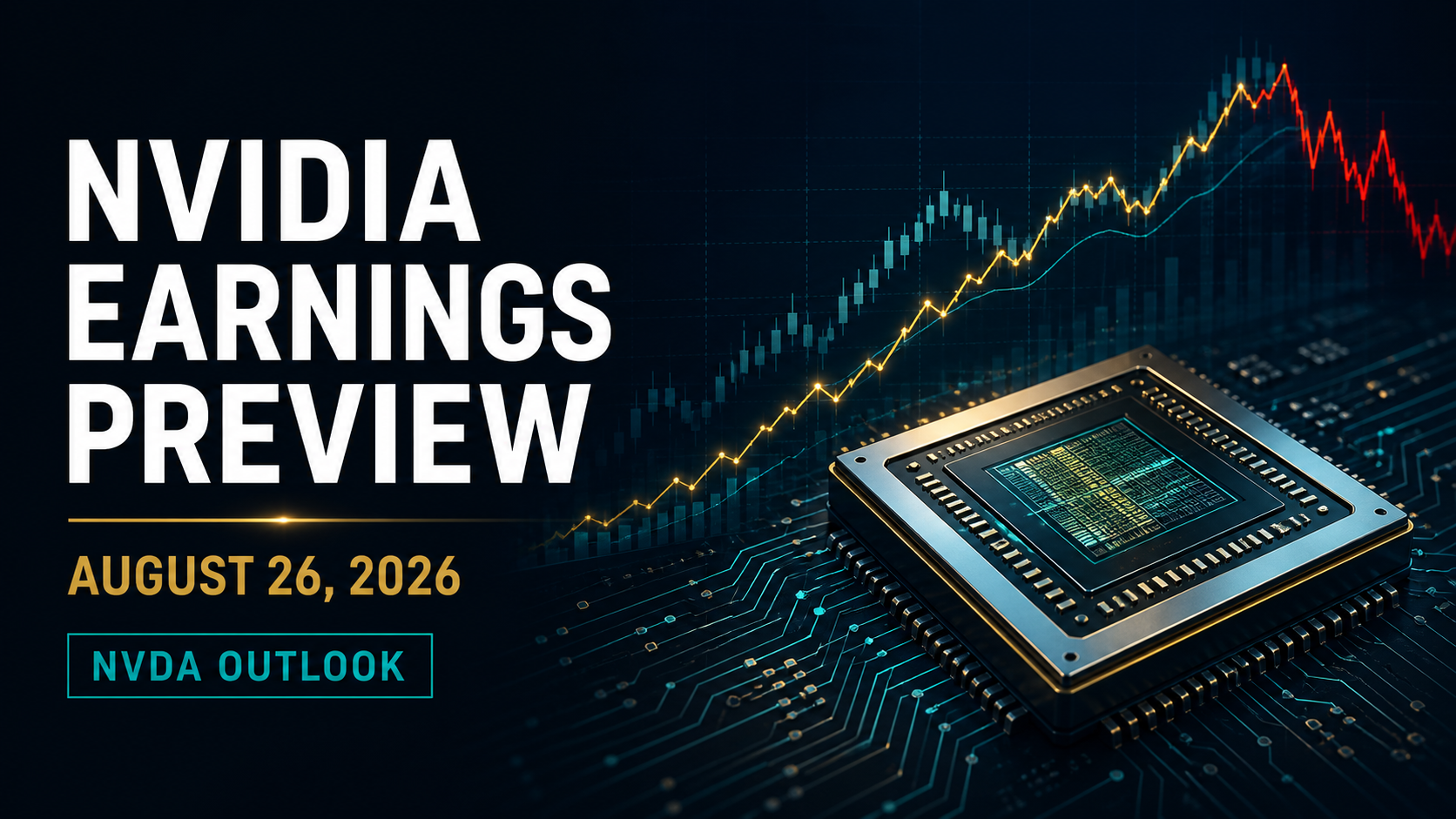
NVIDIA is scheduled to report its fiscal second-quarter 2027 financial results on Wednesday, August 26, 2026, after the U.S. stock market closes.
The report could become one of the most important market events of the quarter. NVIDIA is not only the leading supplier of artificial-intelligence processors—it is also one of the largest companies in the S&P 500 and Nasdaq. A significant reaction in NVDA could therefore influence semiconductor stocks and the broader market.
What Wall Street Expects
Current consensus estimates are approximately:
- Revenue: $91.9 billion
- Adjusted earnings per share: $2.08
- NVIDIA revenue guidance: $91 billion, plus or minus 2%
- Expected adjusted gross margin: approximately 75%
These expectations follow another exceptional quarter. NVIDIA reported first-quarter revenue of $81.6 billion, representing year-over-year growth of 85%. Data Center revenue reached $75.2 billion and increased 92% from the previous year.
The company also reported adjusted earnings of $1.87 per share and projected approximately $91 billion in second-quarter revenue.
Why Expectations Are So High
Demand for AI infrastructure continues to support NVIDIA’s growth. Major technology companies are investing heavily in data centers, accelerated computing and increasingly sophisticated artificial-intelligence models.
NVIDIA benefits from several important growth drivers:
- Continued adoption of Blackwell and Blackwell Ultra
- Growing demand for AI training and inference
- Significant capital spending by cloud providers
- Expansion of AI factories and enterprise infrastructure
- Strong demand for NVIDIA networking products
- Development of the next-generation Vera Rubin platform
These trends create a strong fundamental backdrop. However, they have also raised investor expectations considerably.
The Most Important Numbers to Watch
1. Revenue and Forward Guidance
A modest revenue beat may not be sufficient to move NVDA significantly higher. Investors will want to see strong guidance indicating that demand remains elevated in the following quarter.
A meaningful increase above Wall Street’s forward expectations would strengthen the bullish case.
2. Data Center Growth
Data Center is NVIDIA’s most important business. Investors should examine whether hyperscale and enterprise demand continue to grow at an exceptional rate.
Any indication that major customers are reducing or delaying AI infrastructure spending could pressure the stock.
3. Gross Margin
NVIDIA expects adjusted gross margin of approximately 75%.
Maintaining that level would demonstrate continued pricing power and operational strength. A noticeable decline—particularly when accompanied by cautious guidance—could concern investors.
4. Blackwell and Vera Rubin Demand
Management’s comments about Blackwell supply, customer demand and the transition to Vera Rubin may be just as important as the reported financial results.
Investors will want confirmation that customers remain committed to NVIDIA’s product roadmap.
5. China and Export Restrictions
NVIDIA did not include Data Center compute revenue from China in its second-quarter outlook. Any change in export policy, product availability or potential Chinese revenue could affect future expectations.
Bullish Scenario
The most bullish outcome would include:
- Revenue comfortably above expectations
- Stronger-than-expected earnings
- Gross margin near or above 75%
- Forward guidance materially above consensus
- Positive commentary about Blackwell and Vera Rubin demand
- Continued strength in hyperscaler spending
Under this scenario, NVDA could break higher and support the broader semiconductor sector.
Bearish Scenario
The bearish outcome would include:
- Revenue close to or below expectations
- Forward guidance that disappoints investors
- Weakening gross margin
- Evidence of slower AI infrastructure spending
- Product-transition or supply challenges
- Cautious comments about demand or China
Because expectations are so high, even respectable results could trigger selling if management’s outlook does not exceed the market’s assumptions.
Our NVDA Earnings Outlook
Our fundamental outlook is bullish, but we are more cautious about the immediate stock-price reaction.
Estimated scenarios:
- Bullish reaction: 60%
- Neutral or volatile reaction: 25%
- Bearish reaction: 15%
NVIDIA appears capable of reporting another strong quarter. Nevertheless, the stock faces a demanding hurdle. Investors already expect rapid growth, strong margins and optimistic guidance.
The key question is therefore not simply whether NVIDIA beats estimates. The real question is whether the company exceeds the elevated expectations already reflected in NVDA’s valuation.
Final Takeaway
NVIDIA remains exceptionally well positioned within the global expansion of artificial-intelligence infrastructure. Its revenue growth, market leadership and product pipeline support a positive long-term outlook.
For the earnings announcement, however, investors should prepare for volatility. A strong report accompanied by materially higher guidance would support a bullish reaction. A small beat with ordinary guidance could result in a muted response or a “sell the news” decline.
Investors should manage position size carefully and avoid making decisions based solely on the initial after-hours price movement. The earnings call, forward guidance and management commentary will provide the clearest picture of NVIDIA’s next stage of growth.
Sources: NVIDIA Investor Relations and current analyst consensus estimates.
Disclaimer: This article is for educational and informational purposes only. It does not constitute investment, trading, tax or financial advice. Investing involves risk, including the possible loss of principal.