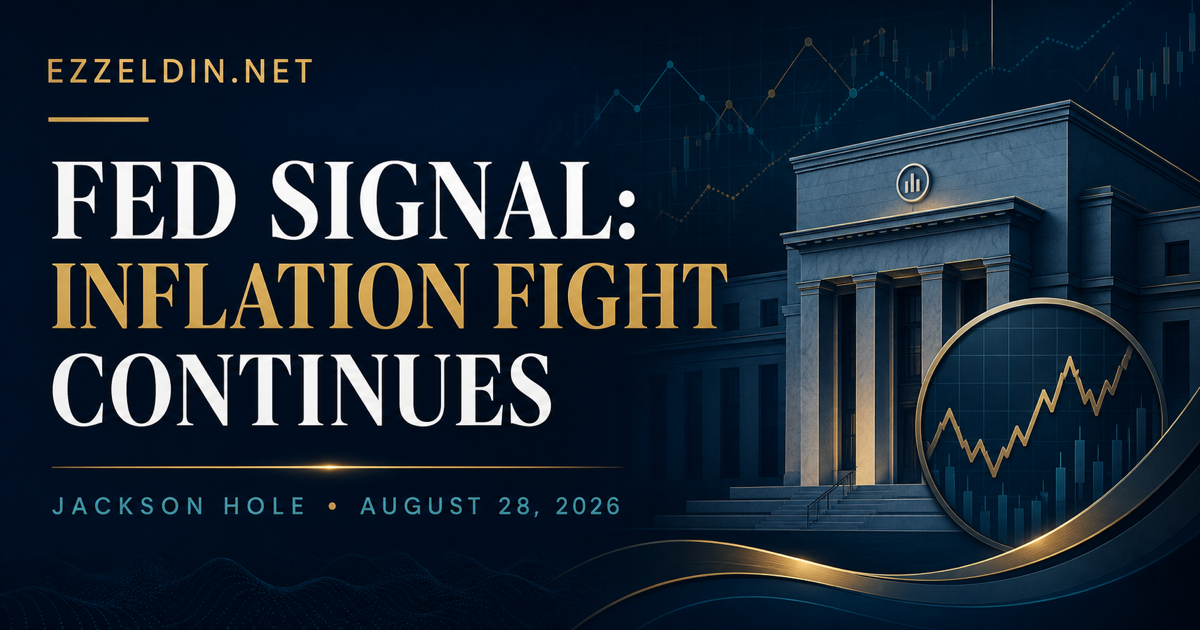
Federal Reserve Chair Kevin Warsh used his first Jackson Hole keynote as chairman to send a deliberately firm—but not mechanically prescriptive—message: inflation remains too high, the economy and labor market are resilient, and the Fed must be prepared to do more if underlying price pressures do not move clearly and quickly toward its 2% goal.
This was a Jackson Hole speech—not an FOMC decision
This was not an FOMC rate-decision meeting, and the Federal Reserve did not change interest rates on Friday. It was a policy speech at the Kansas City Fed’s annual economic symposium in Jackson Hole, Wyoming. The next rate decision will come through the Federal Open Market Committee’s formal process, not from the podium at Jackson Hole. The distinction matters because Warsh explicitly said he was committing to a policy discipline, not announcing a specific decision. Read the complete official Federal Reserve remarks.
Warsh’s policy message: inflation comes first
Warsh reaffirmed that the Fed’s 2% personal consumption expenditures inflation objective is a “firm, fixed target.” He said headline PCE inflation was running at 3.7% over 12 months and at a 4.1% annualized pace over six months. Core PCE and consumer-price measures were also elevated, he said, while improvement during the summer was not enough to prove that the underlying trend had materially improved. Federal Reserve speech, “In Our Time.”
The chair’s test is whether underlying inflation is moving toward 2% “clearly and at sufficient speed.” If it is not, he said, the Fed still has work to do. He also stated that short-term interest rates remain the central bank’s primary tool for achieving price stability and maximum employment, while unconventional measures should generally be reserved for genuine crises.
No promised hike, but no comfort for doves
Confirmed fact: Warsh did not promise a rate increase, specify a meeting, or provide a projected interest-rate path. He noted that most officials chose to await more information at the July meeting and that the committee remained ready to act as circumstances require.
Analysis: The practical implication is hawkish. With inflation still well above target, financial conditions not broadly restrictive, and employment near full strength, the speech preserves the option of another rate increase. It offers little support for investors hoping the Fed would quickly pivot toward easier policy. Still, because Warsh rejected mechanical reaction functions and detailed forward guidance, incoming data—not this speech alone—will decide the timing and scale of any action.
Labor markets look stable and near full employment
Warsh described the labor market as stable and consistent with full employment. He highlighted a 4.1% unemployment rate, low unemployment claims and limited labor-force growth, which means monthly payroll gains can slow without necessarily signaling recession. He acknowledged pressure among some groups, including recent graduates, but said people who want work are generally holding or finding jobs. Official Federal Reserve remarks.
That assessment tilts the near-term balance of risks toward inflation. If employment is already near its sustainable maximum, the Fed has less reason to tolerate above-target inflation in order to protect the job market.
A quieter Fed with less forward guidance
One of the speech’s most consequential structural messages concerned communication. Warsh argued that routine forward guidance has outlived its usefulness in normal times. He warned that quasi-commitments can mislead households and markets, reduce policymakers’ flexibility and create a “hall-of-mirrors” problem in which the Fed watches markets that are themselves primarily watching the Fed.
Warsh wants markets to pay more attention to economic fundamentals and less to decoding every central-bank sentence. For investors, that could mean greater sensitivity to inflation, employment and activity data—and more volatility around releases—because the chair is unlikely to pre-announce the policy path.
AI could reshape growth—but not today’s decision
Warsh called the current period a potential historical hinge point as artificial intelligence drives rapid capital spending and could lift productivity. He said AI-related development likely accounted for more than half of this year’s capital-expenditure growth and announced that Fed task forces are studying productivity and jobs. But he clearly separated that longer-run work from current policy: the task forces’ future recommendations have no bearing on today’s decisions. Federal Reserve speech.
He also portrayed present financial conditions as supportive rather than restrictive, citing strong corporate profits, narrow credit spreads, healthy consumer spending and relatively easy business lending, while noting strains in housing and agriculture.
Initial market reaction
At 10:10 a.m. EDT, shortly after the prepared text was released, the S&P 500 was virtually unchanged, the Dow Jones Industrial Average was up about 0.1%, and the Nasdaq Composite was down 0.2%. Treasury yields initially zigzagged as traders weighed the inflation warning against the lack of a specific rate signal. Associated Press market update.
The dollar had been little changed near a one-week high before the speech, while benchmark 10-year Treasury yields were near 4.68%. Brent crude was around $89.63 a barrel and headed for a weekly decline amid developments in the Strait of Hormuz. Those dollar and oil readings were pre-speech context, not evidence of a Warsh-driven move. Reuters pre-speech market snapshot.
Analysis: The muted stock response suggests the speech was firm but not a shock. The bond market’s two-way movement is consistent with competing forces: the Fed’s inflation bias argues for higher short-term rates, while the refusal to give a timetable limits conviction about the next move.
What to watch next
- Inflation breadth and speed: Warsh emphasized trends, including how many PCE components are rising faster than 3%, rather than one favorable monthly print.
- The next FOMC meeting: Watch the statement, vote and press conference for evidence that the committee is moving from patience to action.
- Labor-market resilience: A meaningful rise in unemployment or claims could alter the Fed’s balance of risks.
- Treasury-market volatility: Long-term yields, the dollar, credit spreads and commodity prices are among the market signals Warsh said the Fed monitors.
- Communication changes: Fewer policy hints may make the economic data—and disagreement among Fed officials—more market-moving.
The bottom line is that Jackson Hole did not produce a rate decision. It produced a policy framework: inflation is the immediate priority, the economy can withstand restraint, and the Fed will keep its options open while saying less about the path in advance.
Disclaimer: This article provides general market information and analysis. It is not personalized financial, investment, tax or legal advice. Markets involve risk, and readers should conduct their own research or consult a qualified professional before making financial decisions.