Active traders face a constant stream of information: index movements, volume, technical levels, market breadth, sector performance, breaking news, and rapidly moving stocks. Reviewing everything separately makes it difficult to answer the most important question:
What is the market environment right now?
The EZZELDIN AI Market Agent helps answer that question. It combines multiple market indicators into one compact, transparent assessment designed to support—not replace—a trader’s judgment.
What the Market Agent Does
During regular U.S. market hours, the Market Agent evaluates available data and classifies the environment as:
- Bullish: Evidence suggests buyers control market momentum.
- Bearish: Evidence suggests sellers control market momentum.
- Neutral: Signals are mixed, incomplete, or insufficiently strong.
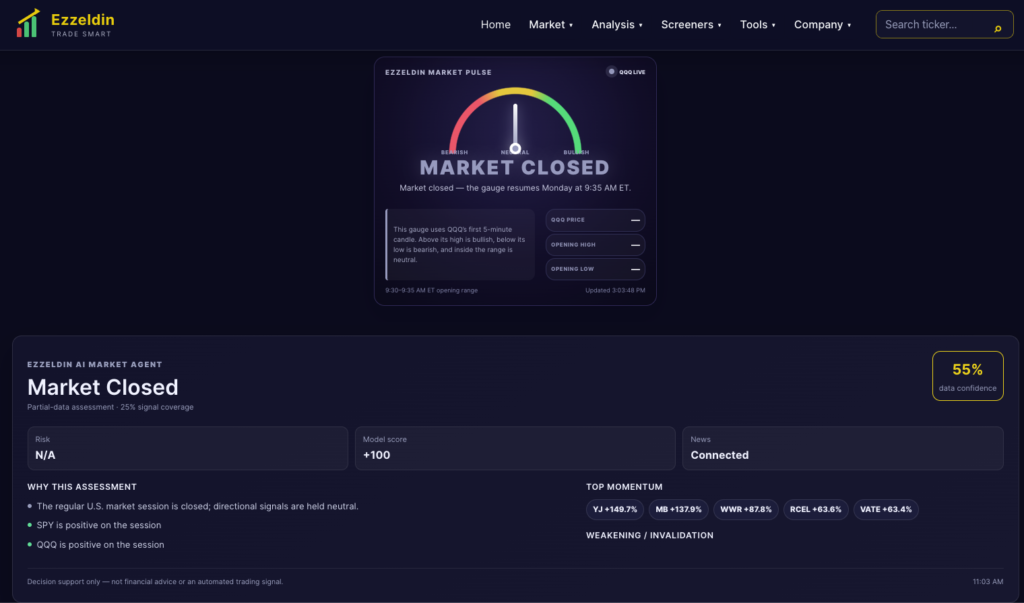
- Market Closed: Directional assessments are paused outside regular trading hours.
The Agent refreshes automatically every five minutes. It does not place trades, connect to a brokerage account, or promise future market performance.
Its purpose is to organize market evidence and explain what that evidence currently suggests.
The Signals Behind the Assessment
The Market Agent combines several complementary signals rather than depending on one indicator.
SPY and QQQ Direction
SPY represents the S&P 500, while QQQ tracks the Nasdaq-100. Together, they provide useful context about broad-market and technology-led performance.
When both are advancing, the environment may be more supportive of long opportunities. When both decline, traders may need to exercise greater caution. If they disagree, the market may be fragmented or rotational.
First Five-Minute Opening Range
The first five-minute candle establishes an early reference range after the market opens.
The Agent monitors whether SPY and QQQ are:
- Above the opening-range high
- Below the opening-range low
- Still trading inside the opening range
A confirmed move above the range can indicate strengthening momentum. A move below it can indicate weakness. Remaining inside the range generally supports a neutral interpretation.
The opening range is only one piece of evidence. It is not treated as a complete trading strategy.
VWAP
Volume-Weighted Average Price, commonly called VWAP, estimates the average price at which an instrument has traded during the session, weighted by volume.
Trading above VWAP may indicate that buyers have greater intraday control. Trading below VWAP may indicate that sellers have greater control.
The Agent evaluates VWAP alongside market direction and opening-range behavior rather than relying on it in isolation.
Volume and Relative Volume
Price movement becomes more meaningful when supported by participation.
Relative volume compares current trading activity with what would normally be expected at that point in the session. Strong price movement accompanied by elevated relative volume may deserve more attention than a similar move occurring on weak participation.
The Agent uses relative volume to confirm conviction. It does not automatically interpret high volume as bullish because unusually high activity can accompany both buying and selling.
Market Breadth
An index can rise even when only a small number of large companies are advancing. Market breadth helps reveal what is happening beneath the index level.
The Agent reviews a representative group of actively traded stocks and compares the number advancing with the number declining.
Broad participation can strengthen a market assessment. Narrow participation may lower confidence or highlight increased risk.
Sector Leadership
Markets frequently rotate between technology, financials, energy, healthcare, industrials, consumer sectors, utilities, and other groups.
The Agent compares major sector ETFs to identify leadership and determine whether strength or weakness is broadly distributed.
For example, a rising QQQ supported by technology and communication-sector leadership may present a more coherent environment than a rising index accompanied by broadly negative sector performance.
Market Movers and News
The Agent displays leading momentum stocks and checks whether the market-news feed is available.
This helps traders quickly identify where unusual price activity is occurring and whether news may be contributing to heightened volatility.
A stock appearing under Top Momentum is not a recommendation to buy it. Large percentage moves can involve low-priced, low-liquidity, or unusually risky securities. Every stock still requires individual research.
Understanding the Confidence Score
The confidence score describes the strength and consistency of the available evidence. It is not a probability that the market will rise or fall.
For example, a 70% Bullish confidence score does not mean there is a 70% probability that stocks will increase. It means the indicators available to the model are providing a relatively consistent bullish assessment.
Confidence is influenced by:
- Agreement between SPY and QQQ
- Position relative to VWAP
- Opening-range confirmation
- Relative-volume participation
- Market breadth
- Sector alignment
- Overall data availability
Conflicting signals reduce confidence. Missing signals reduce data coverage.
Why Signal Coverage Matters
The Agent separately displays signal coverage because confidence should never conceal missing information.
A partial-data assessment means the Agent could retrieve only part of the information used by its complete model. This can happen:
- Outside regular market hours
- Before the opening range has formed
- During provider interruptions
- When an API plan does not include a particular dataset
- When a data source returns delayed or incomplete information
When coverage is below 50%, the Agent holds its directional assessment Neutral. This prevents a small number of signals from creating an overly strong conclusion.
Outside regular market hours, it displays Market Closed and pauses directional classification.
Risk and Invalidation Conditions
A useful assessment should explain not only why it exists but also what could weaken it.
The Agent therefore displays a risk level and invalidation conditions.
If the environment is Bullish, weakening conditions might include SPY or QQQ losing VWAP or falling below an opening-range level.
If the environment is Bearish, invalidation might include those benchmarks reclaiming VWAP or moving back above important intraday levels.
A Neutral environment may become directional if both benchmarks confirm a break outside their opening ranges with sufficient participation.
These conditions encourage traders to think in scenarios instead of treating an assessment as permanent.
Benefits for Traders
Faster Market Orientation
The Agent condenses several market dimensions into one readable component. This can reduce the time required to determine whether the environment is broadly supportive, defensive, or indecisive.
Transparent Reasoning
The tool explains why it reached its assessment. Traders can review the reasons and decide whether they agree instead of trusting an unexplained signal.
Better Context for Individual Stocks
A strong stock trading in a weak market may behave differently from a strong stock supported by favorable index direction, breadth, and sector leadership.
The Agent provides broader context before a trader evaluates an individual opportunity.
More Consistent Decision-Making
Fast-moving markets can encourage emotional reactions. A structured assessment creates a repeatable checklist based on observable data.
It cannot eliminate emotion, but it can help traders pause and review the evidence.
Clearer Risk Awareness
The Agent does not only highlight opportunity. It also reports incomplete data, conflicting evidence, risk level, and weakening conditions.
Automatic Updates
The five-minute refresh cycle keeps the assessment current without requiring the visitor to reload the homepage manually.
What the Market Agent Does Not Do
The EZZELDIN AI Market Agent is not:
- An automatic trading system
- A brokerage or order-entry tool
- A guarantee of profits
- A price-prediction engine
- A replacement for research
- Personalized investment advice
It cannot predict unexpected news, market halts, liquidity changes, or sudden institutional activity. Every model can be wrong, and even a well-supported market assessment can reverse quickly.
A Practical Way to Use It
A trader might use the Agent as the first step in a broader workflow:
- Review whether the environment is Bullish, Bearish, Neutral, or Closed.
- Check signal coverage before relying on the assessment.
- Read the reasons instead of focusing only on the headline.
- Review risk and invalidation conditions.
- Examine sector leadership.
- Investigate individual momentum stocks independently.
- Define personal entry, exit, and risk-management rules.
- Make the final decision independently.
The Agent is most useful as a market-context layer—not as a standalone instruction to enter a trade.
Built for Future Expansion
The current release activates the Market Agent as the first layer of a broader architecture:
Market Agent → Sector Agent → Stock Agent
Future Sector Agent capabilities could provide deeper analysis of industry leadership and rotation. A Stock Agent could combine company-specific price action, VWAP, volume, technical indicators, news, and overall market context.
Keeping these layers separate makes the system easier to understand and helps prevent a stock-level signal from being confused with the broader market environment.
The Bottom Line
The EZZELDIN AI Market Agent is designed to make complex market information easier to interpret.
Its value is not in claiming certainty. Its value comes from combining relevant signals, disclosing missing information, explaining its reasoning, identifying risk, and showing what could invalidate the current assessment.
In a market where information moves quickly, better organization and clearer context can be meaningful advantages.
The Market Agent supports the decision. The trader still makes it.
Important disclosure: The EZZELDIN AI Market Agent is provided for informational, research, and educational purposes only. It does not provide personalized investment advice or execute trades. Market data may be delayed, incomplete, or inaccurate. Trading and investing involve substantial risk, including possible loss of principal.