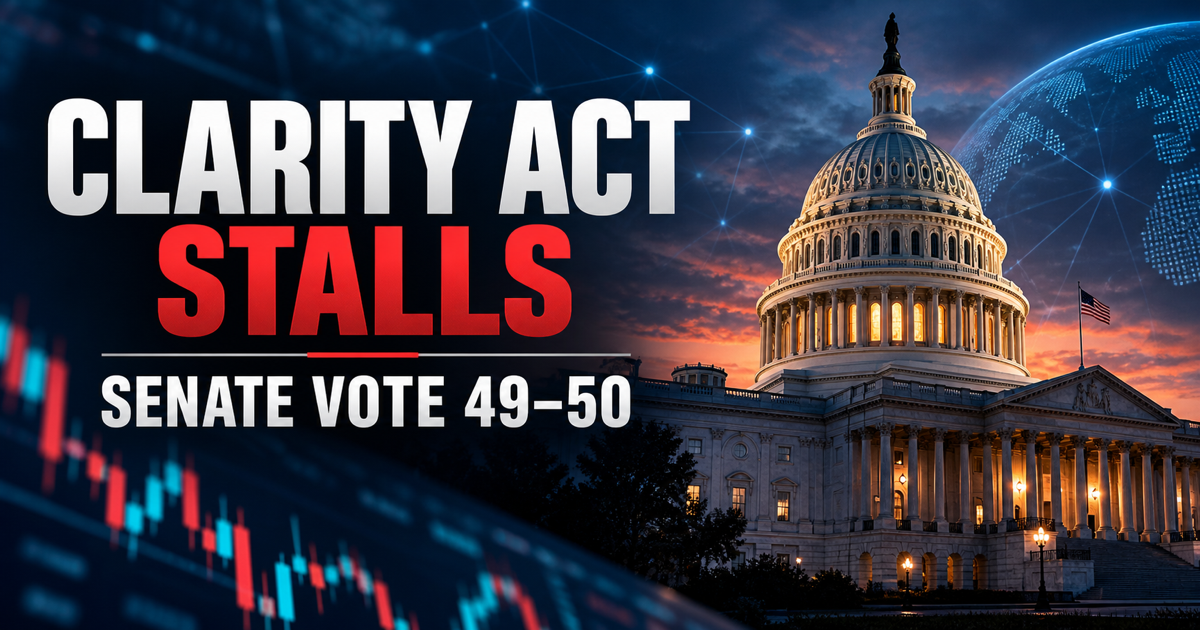
The U.S. Senate failed Tuesday to advance the Digital Asset Market Clarity Act, dealing a major setback to legislation intended to establish a federal regulatory framework for cryptocurrency and other digital assets.
Senators voted 49–50 on the motion to invoke cloture on the motion to proceed to H.R. 3633. Because cloture required 60 affirmative votes, the motion was rejected and the Senate did not move forward with debate on the measure.
This was a procedural vote—not a final vote on passage of the CLARITY Act. The bill remains legislation that previously passed the House, but Tuesday’s result blocks its immediate path forward in the Senate.
What the Senate Voted On
The question before senators was whether to end debate on the motion to proceed and formally take up H.R. 3633. The scheduled cloture vote was the bill’s first major test on the Senate floor. A simple majority was not sufficient: under Senate procedure, the motion needed 60 votes.
The 49–50 tally therefore left the legislation 11 votes short of the threshold. The result should not be described as the Senate rejecting the bill on final passage, because senators never reached that stage.
What the CLARITY Act Would Do
The Digital Asset Market Clarity Act seeks to create clearer federal rules for digital commodities and divide regulatory responsibilities between the Commodity Futures Trading Commission and the Securities and Exchange Commission. Supporters argue that a defined market structure would reduce legal uncertainty, protect consumers and encourage responsible innovation in the United States.
Opponents and holdouts have pressed for stronger ethics, consumer-protection and financial-integrity provisions. Those disagreements continued into Tuesday’s procedural vote despite revisions and negotiations before the Senate returned to session.
What Happens Next
The failed cloture vote stalls the measure, but it does not permanently remove H.R. 3633 from the Senate calendar. Senate leaders could seek another vote if negotiations produce enough support, revise the proposal, or pursue parts of the framework through another legislative vehicle.
For digital-asset markets, the immediate takeaway is that a comprehensive U.S. market-structure law is not moving to Senate debate under the current vote count. Existing regulatory uncertainty therefore remains while lawmakers decide whether a new compromise is possible.
Sources
- U.S. Senate — Roll Call Votes, 119th Congress, 2nd Session
- U.S. Senate Democratic Caucus — September 15 Floor Schedule
- Associated Press — Senate Blocks Cryptocurrency Regulation
- Senate Banking Committee — CLARITY Act Committee Action
This article provides general information only and does not constitute legal, investment or personalized financial advice.